
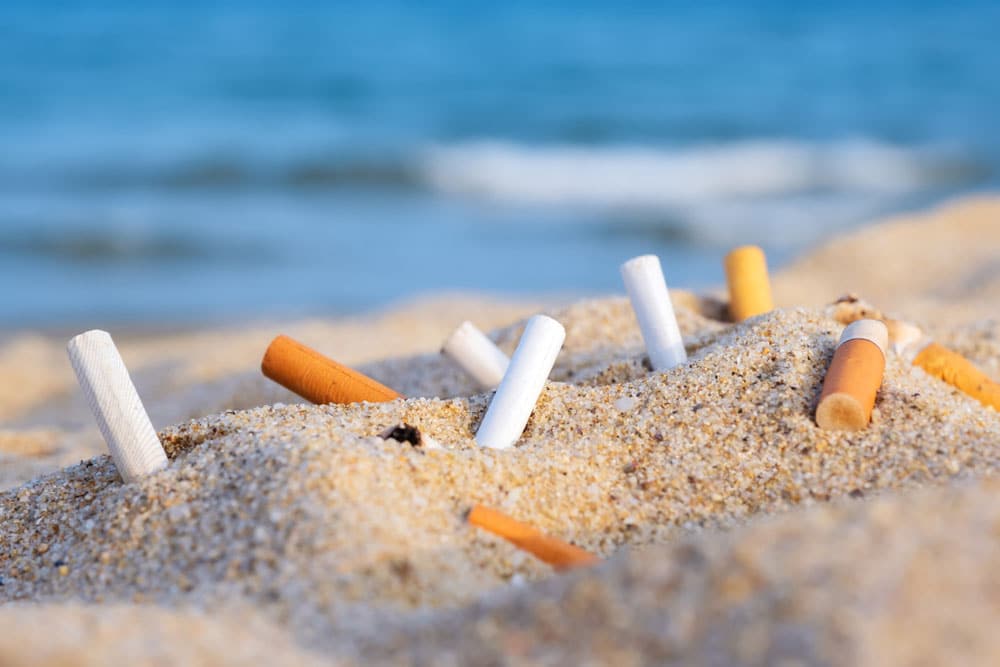
Cigarette stubbornness and pollution: cigarettes also damage the planet's health
Small and unimpressive at first glance, cigarette butts generate a staggering amount of waste every year. It has even become the world’s leading vector of pollution, and is proving to be a scourge for the oceans. Focus on cigarette butt pollution.
Pollution: the cigarette butt, the world's number one waste product
Thrown away without a second thought as soon as the cigarette has finished smoking, the butt may be small, but it’s a source of pollution. While some smokers behave like good citizens and dispose of their butts properly, many still tend to drop them on the ground. It is estimated that several billion cigarette butts land on the ground around the world every day. And of this astronomical quantity, around 40% end up in the oceans.
Far ahead of plastic straws and bags, the cigarette butt is now the world’s leading waste product. It alone accounts for 40% of the waste recovered during clean-up campaigns in towns and along coastlines. Given that it takes between 1 and 12 years to degrade in nature, this is a worrying finding. All the more so when you consider the number of harmful components that will be released as the butt decomposes.
In 98% of cases, the smokeless section of the cigarette contains the filter responsible for preventing some of the most harmful substances from being inhaled by the smoker during tobacco consumption. In other words, cigarette butts are extremely rich in toxic compounds, both for the human body and the environment.
Cigarette butts and water pollution
Whether discarded in the city or in nature, cigarette butts inevitably end up polluting the planet’s water reserves. It is estimated that a single cigarette butt can contaminate up to 500 liters of water. And this cigarette residue doesn’t distinguish between drinking water and water unfit for consumption!
Apart from the potential contamination of drinking water, the pollution generated by cigarette butts mainly affects aquatic ecosystems, both in the sea and in freshwater. The waste generated by tobacco consumption is partly responsible for the destruction of marine flora and fauna.
Of the 4,000 toxic substances contained in a cigarette butt, around 2,500 remain after the water has been filtered. In practical terms, this means that if the water treated by your local wastewater treatment plant has been contaminated by the pollutants present in a cigarette, many of these will remain in the water that comes out of your tap.
A national guarantee
Our laserOstop centers guarantee free treatment throughout Saudi Arabia.
Practitioners at your service
At your service, 6 days a week
No contraindication
The laserOstop method is a personalized protocol that can be adapted to each individual, with no contraindications.
Discretion & confidentiality
Our laserOstop centers are committed to maintaining the confidentiality of your treatments in order to protect your integrity.
Cigarette butt pollution: thousands of chemicals in the environment
Not only is it visually unappealing to see mountains of cigarette butts littering the ground, it’s also a worrying source of pollution. Firstly, the filter itself contains plastics, notably cellulose acetate, which degrades very slowly. On the other hand, it’s loaded with the substances it once filtered, and these are nothing to write home about. Between heavy metals (cadmium, lead, mercury), recognized poisons (hydrocyanic acid, arsenic) and various chemical substances (ammonia, naphthalene, nicotine, etc.), a veritable chemical cocktail can be found in nature.
When throwing away a cigarette butt costs billions in pollution control
While throwing away a cigarette butt is sometimes done unconsciously or without thinking of the consequences, recovering the billions of tonnes of waste generated in this way requires heavy financial and human investment. Although large-scale waste collection operations are regularly launched by local authorities and associations, they are far from sufficient.
It is therefore generally the responsibility of the municipal waste services to collect and treat the waste generated by smokers. Obviously, this represents a substantial cost, often financed by local taxes. In the end, everyone pays: the smoker who exposes his or her body to the toxic substances in cigarettes, the local authority responsible for collecting abandoned cigarette butts, and even non-smokers who pay the local tax.
How can you stop polluting if you're a smoker?
Demonstrating good citizenship
Pollution from cigarette butts is just as harmful to the smoker’s body as it is to the planet. If cigarettes are essential to your comfort, think about disposing of what’s left of them in an urban ashtray or a nomad ashtray that you keep with you. This is all the more relevant as littering is now punishable in Saudi Arabia.
Stop smoking with laserOstop
Perhaps the best way to protect your health and that of the environment is simply to stop smoking? Smoking cessation gives you the opportunity to detoxify your body, stop exposing those around you to passive smoking and put an end to the problem of disposing of cigarette butts.
laserOstop is a method for quitting smoking using a laser that works by photobiomodulation to put an end to the incessant urge to have a cigarette. After following the laserOstop method, this painless technology with no side effects has already helped thousands of smokers give up cigarettes. Ultra-effective, it requires just one one-hour session at a specialized laserOstop treatment center to produce results!
Finally...
Quitting smoking addresses two of the main environmental problems. Not only will there be no more butts to throw away, but you’ll also be helping to reduce the need to produce tobacco. Yet growing and drying the leaves used in the cigarette industry causes more deforestation every year, and generates greenhouse gases. Quitting smoking is an eco-responsible gesture in many ways!